
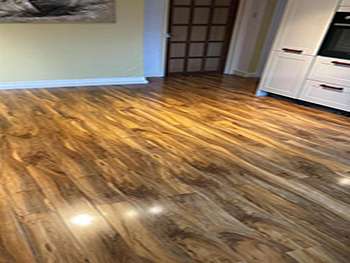
What a sagging or bouncy floor is actually telling you
A dip in a floor or a noticeable bounce underfoot can mean anything from an undersized joist to genuine timber decay, and the right fix depends entirely on which it is.
Older properties across Torbay and the South Hams were often built with timber joist sizes that were adequate by the standards of their time but feel undersized against modern expectations of a stiff, level floor. A gentle, even dip across a whole room is usually a sign of joists that were always lightly built for their span, while a localised sag in one area points to something more specific happening to a particular joist or its support.
Moisture is the other major factor in this part of Devon. Poor sub-floor ventilation in solid-walled properties, combined with damp coming up through unlined ground floors, creates conditions where floor timbers can weaken or rot at the point where they sit in the wall, and this often shows up first as a soft or bouncy spot near an external wall rather than in the middle of the room.
Working out whether a sagging floor is a long-standing, stable characteristic of an older build or an active, worsening problem is the first step before deciding what work, if any, is needed.
Common causes of sagging or bouncy floors
Undersized or over-spanned joists are common in properties built before span tables were standardised, and these floors are often stable but simply springier than a modern build. Notching or drilling of joists for pipework and cabling over the years, sometimes beyond what the timber can safely lose, is another frequent cause of localised weakness.
Timber decay where a joist end sits in a damp external wall is a more serious cause, often linked to poor sub-floor ventilation, blocked air bricks, or damp penetrating the wall at that point. Settlement of an internal sleeper wall or support pier beneath the joists can also cause a floor to dip in one specific area rather than across the whole room.
- Joists sized or spaced adequately for older standards but springy by today's expectations
- Excessive notching or drilling for services weakening individual joists
- Joist end decay from damp penetration or blocked sub-floor ventilation
- Settlement or failure of a sleeper wall or support pier
- Loose or failed strutting between joists increasing flex
Causes specific to South Devon's older stock
Many solid-walled cottages and terraces in the area have suspended timber ground floors that rely entirely on air bricks for ventilation, and these are easily blocked by raised external ground levels, planting or render carried down over them during past repairs. Once ventilation is restricted, moisture builds up under the floor and joist ends nearest the damp wall are usually the first timbers affected.
Coastal humidity generally keeps sub-floor voids damper for longer after wet weather than an inland equivalent, which is another reason joist decay tends to start at the perimeter of a room near external walls rather than in the centre.
Telling a structural sag apart from a cosmetic dip
A floor that has always had a slight, consistent slope and shows no recent change is usually just a characteristic of the original build and not a cause for concern. A floor that has visibly changed, that bounces noticeably when walked across, or that has a sag concentrated in one small area rather than spread evenly, needs a proper look underneath.
Checking the sub-floor void directly, where access allows, for timber that feels soft, damp air, or visible fungal growth is the most reliable way to separate an old, settled floor from one that is actively deteriorating.
What a proper repair involves
Where joists are sound but under-strength for their span, the usual fix is sistering new timber alongside the existing joists to add stiffness without disturbing the floor above. Where decay is found at a joist end, the affected section is cut out and replaced, and crucially the cause of the damp is addressed at the same time, whether that means clearing blocked air bricks, lowering external ground levels, or repairing a defective wall.
Any repair to a suspended timber floor should also check and restore sub-floor ventilation, since replacing decayed timber without solving the moisture source simply resets the clock on the same problem.
When to act
A stable, long-standing dip with no recent change is generally low priority and can be left as a characteristic of the building. A floor that has started to sag more noticeably, feels soft underfoot, or is near a damp external wall should be checked promptly, since timber decay spreads while conditions stay damp.
Musty smells from under the floor or visible fungal growth on skirting are a clear signal to get the sub-floor void inspected without delay, as decay in one joist can spread to neighbouring timbers if left.
Common questions
Is a bouncy floor always a sign of a serious problem?
Not necessarily. Many older properties have springier floors simply because joists were sized to older standards. It becomes a concern when the bounce is new, worsening, or concentrated in one area rather than spread evenly.
What causes joist ends to rot near an external wall?
Usually a combination of blocked sub-floor ventilation and damp penetrating the wall at joist level. Once air bricks are blocked or ground levels are raised, moisture builds up around the joist end and timber decay can set in.
Can sagging joists be fixed without lifting the whole floor?
In many cases yes, particularly for localised weakness, where new timber can be sistered alongside existing joists from below via the sub-floor void, avoiding disturbance to the floor finish above.
How do I know if my sub-floor ventilation is adequate?
Check that external air bricks are not blocked by planting, render or raised paving, and that there is a clear route for air to pass under the whole floor. Restricted airflow in even one area can allow damp to build up locally.
Tell us about the job and we’ll come back with a clear next step.
Serving Paignton, Torbay & South Devon. Mon–Fri 08:00–17:00.
- Damp in solid wallsHow to diagnose damp correctly in a solid wall before spending on treatment.
- Cracked render repairHow to read a render crack correctly before deciding on a patch or full repair.
- Flat roof leaksHow to trace a flat roof leak to its real cause before patching or recovering.
- Rotten window framesHow to catch coastal window rot early and what a splice repair involves.