
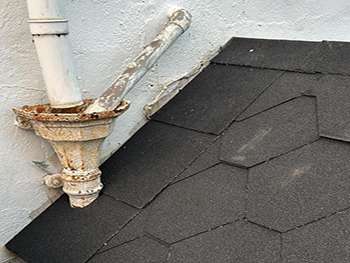
Tracing a flat roof leak back to its real source
Water on a flat roof can travel a surprising distance before it shows as a stain inside, which is why so many flat roof leaks get chased in the wrong spot.
Flat roofs on extensions, garages and dormers across Torbay take a heavier weathering load than a pitched roof because water sits and drains slowly rather than running straight off, and coastal wind exposure adds extra strain at every upstand and edge detail. Most of the flat roofs we get called to are covered in traditional felt, and age combined with sun exposure and standing water is what eventually causes them to fail.
The tricky part with flat roofs is that the leak point on the surface is rarely directly above the stain on the ceiling below. Water can travel along the underside of the deck or along a joist before dropping, so tracing the fault properly takes more than looking straight up from the damp patch.
Understanding the common failure points on a flat roof, and how they differ from a felt roof simply reaching the end of its life, makes the difference between a targeted repair and an unnecessary full recover.
Where flat roofs typically fail
Upstands, where the roof covering turns up against a wall or parapet, are one of the most common failure points because movement between the roof deck and the wall can pull the felt away from the joint over time. Roof edges and drip trims are another weak spot, especially where fixings have corroded in salt air and allowed water to track underneath the covering.
Standing water is a major contributor to failure on older flat roofs that were laid without enough fall to shed rain properly. Ponding water accelerates the breakdown of felt through repeated freeze-thaw cycles and UV exposure at the surface, eventually opening up splits and blisters that let water in.
Causes we see in South Devon's coastal conditions
Salt-laden air corrodes exposed metal trims and fixings faster than inland, which loosens edge details and creates entry points for water well before the felt itself is worn out. Strong coastal winds also lift and work at loose edges and upstands over time, gradually widening small gaps into larger openings.
Many flat roofs in the area were built to the minimum fall or less, which was common practice decades ago, and this leaves them prone to standing water that shortens the life of the covering considerably compared with a roof built to a proper fall from the outset.
- Perished or split felt at upstands where movement pulls the joint apart
- Corroded trims and fixings from long-term salt air exposure
- Standing water from insufficient fall accelerating covering breakdown
- Blocked or undersized outlets causing water to back up
- Sun-damaged felt that has become brittle and cracked
Telling a leak apart from condensation under the deck
A genuine leak usually appears or worsens directly after or during rain, and the stain tends to have a defined edge that follows the shape of water tracking along a timber. Condensation forming under a poorly ventilated flat roof deck, by contrast, tends to appear gradually regardless of rainfall and often affects a wider, more diffuse area.
Checking whether the roof has adequate ventilation at the eaves, and whether the pattern of staining changes with weather or stays fairly constant, helps separate a covering fault from a build-up of trapped moisture within the roof construction itself.
What a proper repair involves
A localised leak at an upstand or trim can often be repaired by cutting out the failed section and reinstating it correctly, provided the rest of the covering is in reasonable condition. Where ponding is widespread or the felt is generally perished, patch repairs tend to be short-lived and a full recover with a modern covering and correct falls is the more durable option.
Any proper repair also reviews the roof's drainage, checking outlets are clear and appropriately sized, since fixing the covering without addressing standing water only delays the next failure.
When to act
A small stain that appears once after heavy rain is worth monitoring, but a flat roof leak that recurs after every downpour should be looked at before it starts affecting the timber deck beneath, since repeated wetting can lead to rot that is far more costly to put right.
If a flat roof is over fifteen to twenty years old and showing visible cracking, blistering or standing water, it is worth having it assessed even without an active leak, since the covering is likely approaching the end of its useful life.
Common questions
Why does the leak show up somewhere different to where the roof looks damaged?
Water often runs along the underside of the roof deck or along a joist before dropping through the ceiling, so the visible fault on the roof surface and the stain inside can be some distance apart. Proper tracing needs access to both.
Is standing water on a flat roof always a problem?
A small amount of temporary ponding after rain is common, but water that still sits after 48 hours indicates insufficient fall and will shorten the life of the covering, so it is worth addressing rather than ignoring.
Can a flat roof be patched instead of fully replaced?
A patch is reasonable for a single, clearly identified fault on an otherwise sound roof. If the covering is generally aged, cracked or ponding across large areas, a patch is likely to fail again soon and a recover is the better long-term option.
How long does a felt flat roof typically last on the coast?
Coastal exposure to salt air, wind and strong sun tends to shorten the working life of felt compared with sheltered inland locations, which is why regular checks matter more on roofs facing the sea.
Tell us about the job and we’ll come back with a clear next step.
Serving Paignton, Torbay & South Devon. Mon–Fri 08:00–17:00.
- Damp in solid wallsHow to diagnose damp correctly in a solid wall before spending on treatment.
- Cracked render repairHow to read a render crack correctly before deciding on a patch or full repair.
- Sagging floor joistsHow to tell a stable old floor from active joist decay before repairing.
- Rotten window framesHow to catch coastal window rot early and what a splice repair involves.