
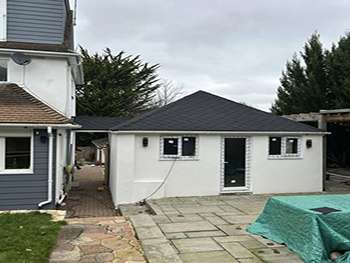
Reading render cracks correctly before you repair or repaint
Not every crack in render means the same thing, and painting over hairline cracking without understanding the cause usually just delays a bigger repair.
Render takes the brunt of South Devon's weather, from driving coastal rain to strong sun on south-facing elevations, and it is designed to move slightly as the building behind it expands and contracts through the seasons. Some hairline cracking is normal and cosmetic. Other cracking is a sign that water is getting behind the render or that something structural is moving beneath it.
The type of render matters as much as the crack itself. Sand and cement render behaves very differently to a modern silicone or monocouche system, and a repair method that works on one can fail quickly on the other. Older properties re-rendered in cement over a lime substrate are particularly prone to cracking because the two materials move at different rates.
Before any repair, the job is to work out whether the cracking is surface-level crazing, a sign of render debonding from the wall, or evidence of movement in the structure itself, because each needs a different response.
Types of render cracking and what they mean
Fine, web-like crazing across a large area is usually shrinkage cracking from the render curing too quickly, and it is mostly cosmetic if the render is still firmly bonded to the wall. Straight vertical or diagonal cracks, particularly ones that run from a window or door corner, are far more likely to be linked to movement in the wall behind.
Cracks that follow the line of a lintel, or that widen at one end, need closer attention because they can indicate a failing lintel or differential movement between an extension and the original building, both of which are common in Devon properties that have been extended over the years.
Causes specific to South Devon properties
Salt-laden coastal air accelerates the breakdown of render, particularly at joints and around openings where wind-driven rain concentrates. Thermal movement is also more pronounced on exposed elevations facing the sea, where render can heat and cool faster than on a sheltered inland wall.
In older properties, cement render applied over an original lime wall is a frequent cause of cracking because the rigid cement layer cannot flex with the more flexible masonry beneath it, so cracks form at the weakest points, often around openings and at the junction with different building phases.
- Cement render over a flexible lime or timber-framed substrate
- Wind-driven coastal rain concentrating stress at openings and joints
- Movement between an original building and a later extension
- Render applied too thickly or too fast, causing shrinkage cracking
- Missing or degraded movement joints on larger elevations
Telling cracked render apart from structural cracking
The key test is whether the crack exists only in the render or continues through the brick or blockwork beneath it. A crack confined to the render surface, even if it looks alarming, is usually a coating problem. A crack that lines up through mortar joints in the masonry behind, or that you can see from inside the property on the corresponding wall, points to genuine structural movement.
Cracks wider than roughly the thickness of a coin, or ones that continue to grow month to month, warrant a closer structural look rather than a straightforward render patch, particularly if doors or windows nearby have started sticking.
What a proper render repair involves
A lasting repair starts with cutting back the render to sound material around the crack rather than skimming a filler over the top, because a surface fix will telegraph through within a season. Where the substrate itself has failed, sections need to be removed back to the masonry and rebuilt in a compatible material rather than patched with whatever render happens to be on the van.
On older solid walls, that usually means specifying a lime-based render rather than cement so the repair can flex and breathe in the same way as the surrounding original material, preventing the same crack pattern reappearing at the boundary of the patch.
When to act
Hairline crazing can be monitored and dealt with at the next redecoration, but any crack that lets water track behind the render should be treated before winter, since freeze-thaw cycling widens cracks quickly once moisture is trapped inside them.
If a crack is growing, running through masonry joints, or appearing alongside sticking doors and windows, it is worth getting looked at promptly rather than simply repainting, since that combination often points to a cause beyond the render itself.
Common questions
Can I just fill a render crack myself?
For genuine hairline shrinkage cracks, a flexible exterior filler can be adequate. Anything wider, growing, or linked to a corner or lintel is better assessed properly first, since filling over a moving crack rarely holds for long.
Why does cement render crack more than lime render on old walls?
Cement render is rigid and cannot move with a flexible lime or timber-framed wall behind it, so stress concentrates at weak points and cracks. Lime render flexes with the building, which is why it is usually specified for older solid-wall properties.
Does render cracking always mean the wall is unsafe?
No, most render cracking is a coating issue rather than a structural one. It becomes a concern when the crack continues through the masonry behind it or is accompanied by other signs of movement such as sticking doors.
How does coastal weather affect render lifespan?
Salt-laden air and driving rain accelerate wear at joints and openings, and repeated wetting and drying cycles stress the render faster than in sheltered inland locations, which is why coastal elevations often need attention sooner.
Tell us about the job and we’ll come back with a clear next step.
Serving Paignton, Torbay & South Devon. Mon–Fri 08:00–17:00.
- Damp in solid wallsHow to diagnose damp correctly in a solid wall before spending on treatment.
- Flat roof leaksHow to trace a flat roof leak to its real cause before patching or recovering.
- Sagging floor joistsHow to tell a stable old floor from active joist decay before repairing.
- Rotten window framesHow to catch coastal window rot early and what a splice repair involves.