
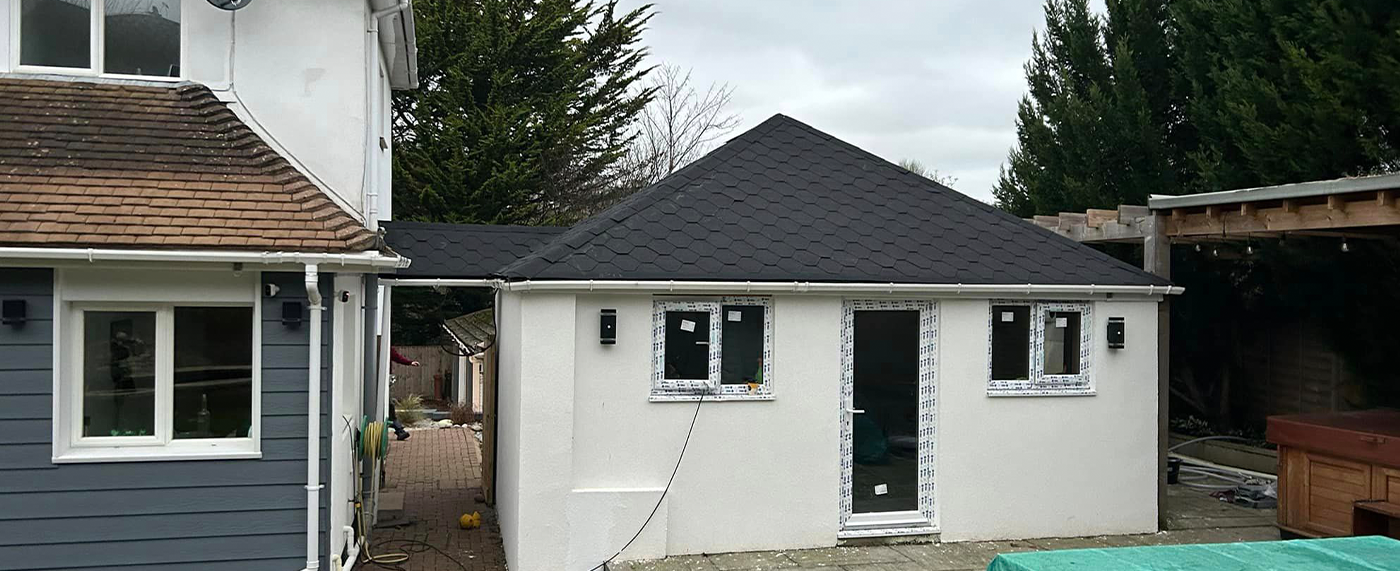
Silicone render vs monocouche: comparing two modern finishes
Both give a smooth, coloured, low-maintenance finish, but they're built up differently and suit slightly different situations.
Silicone render and monocouche render are two of the most requested modern render systems on extensions and full house renders across Torbay and South Devon, and they're often mentioned interchangeably by homeowners who've seen both online without knowing the technical differences. Both give you a smooth, through-coloured, relatively low-maintenance finish on new build cavity walls and extensions, but the way they're built up, applied and priced differs enough that it's worth understanding before you commit to one.
Monocouche, meaning 'single coat', is a factory-made through-coloured render applied in one thicker coat directly onto a suitable background, usually with a mesh-reinforced base coat beneath it on masonry. Silicone render is typically a thin, flexible, water-repellent topcoat applied over a separate reinforced base coat system, giving a slightly different build-up and a different balance of properties.
This guide compares how each performs, what they cost to specify, and which situations suit one over the other on a typical South Devon cavity wall project.
Need this sorted?
Renovations & Refurbishments from ADB SW.
How each system is actually built up
Monocouche render is applied as a single, relatively thick coat, typically machine-sprayed for consistency, directly over a mesh-reinforced scratch coat on blockwork or a suitable substrate. The colour runs through the full thickness of the render, so minor surface scuffs don't show a different colour underneath the way a painted surface would.
Silicone render systems are generally built up as a full render system: a base coat with reinforcing mesh embedded in it, followed by a thin silicone topcoat that provides the colour, texture and the material's characteristic water-repellent, self-cleaning surface properties. The topcoat itself is thinner than a monocouche coat, relying on the base coat system beneath it for the bulk of the render's strength and levelling.
Both systems need a sound, suitable background and correct detailing at movement joints, window reveals and abutments; render failures on either system are far more often down to poor detailing or the wrong background than the render material itself.
Weather performance on an exposed South Devon site
Silicone render is prized for its water-repellent, breathable surface, which sheds rain effectively while still allowing some vapour to pass through, and its self-cleaning properties help it resist the algae and green staining that's a real issue on shaded, damp elevations near the coast. This makes it a strong performer on exposed sites around Torbay and Brixham where wind-driven rain and salt-laden air are a constant factor.
Monocouche render also performs well against weather, particularly because its single-coat application with consistent colour through the thickness means minor surface wear doesn't immediately show, but it's generally considered slightly less effective than silicone at shedding water and resisting algae growth on the most exposed or shaded elevations without additional treatments.
Both systems vastly outperform older sand-and-cement renders in terms of weather resistance and crack resistance, so the choice between them is more of a fine margin than a dramatic difference, and site-specific exposure should guide the final decision.
- Silicone render sheds water and resists algae particularly well
- Monocouche gives consistent colour through the render's full thickness
- Both outperform traditional sand-and-cement render on weather resistance
- Shaded, exposed elevations benefit most from silicone's self-cleaning surface
Renovations & Refurbishments
- Full re-plastering & decoration
- Property remodelling & interior alterations
- The right trades in the right order
Appearance and colour choice
The finish known as silicone coloured render is a thin-coat, through-coloured render applied over the separate base coat.
Monocouche render is available in a wide range of through-colours and various textured finishes, from a fine scraped texture to a coarser dashed effect, and because the colour runs through the material, small scratches or knocks are far less noticeable than they would be on a painted surface. This makes it a popular choice for larger, plainer elevations where a consistent, uniform look is wanted.
Silicone render also comes in an extensive colour range and can achieve a similarly wide variety of textures, and its finish tends to have a slightly more refined, matt appearance that many homeowners prefer for a contemporary extension or full house render. Because it's a thinner topcoat, any damage that goes through to the base coat will show the base coat colour underneath, though repairs are generally straightforward for a competent renderer to match.
Cost and application considerations
Monocouche is often machine-applied, which can make it quicker to cover large, plain elevations, though it still requires skilled application to avoid banding or inconsistent texture, and the equipment and material costs factor into the overall price. It's frequently competitive on larger new build or extension projects where the scale suits a machine-sprayed approach.
Silicone render systems, being a multi-layer build-up with a separate base coat and topcoat, can involve more labour stages, and the overall cost depends heavily on the base coat system specified alongside it. Neither system is reliably cheaper than the other across the board; actual costs depend on wall area, complexity of detailing, access, and the specific products specified, so a proper like-for-like quote is the only reliable way to compare them for your project.
Which suits your project
For a straightforward, larger extension or new build elevation with reasonably plain detailing, monocouche is a well-proven, efficient choice that gives durable colour and good weather resistance. For a more exposed, shaded or coastal-facing elevation where algae resistance and self-cleaning properties matter most, silicone render tends to have the edge.
Neither system is a universal right answer, and the background wall, exposure, budget and aesthetic preference all factor into the decision. If you're planning a render job, whether a full house re-render or a new extension, we're happy to assess your walls and their exposure, talk through both systems honestly, and give you a free, no-obligation quote for whichever suits your property best.
Common questions
Can you apply silicone render over an existing monocouche render?
Generally no, not directly. Compatibility depends on the manufacturer's system and the condition of the existing render, so this needs assessing on a case-by-case basis rather than assumed to be straightforward.
Does monocouche render crack more than silicone?
Both are reinforced systems designed to resist cracking far better than traditional cement render, and cracking in either usually points to a background or detailing problem rather than an inherent weakness in the render material itself.
Which render resists algae better on a shaded wall?
Silicone render's self-cleaning, water-repellent surface generally gives it an edge on shaded or north-facing elevations prone to green staining, though good detailing to shed water away from the wall matters for both systems.
Is one system definitely cheaper than the other?
Not reliably. Costs depend on wall area, background preparation, detailing complexity and the specific base coat and topcoat products specified, so it's worth getting a direct quote comparison for your actual project.
What do K Rend and monocouche mean?
K Rend is a brand that makes both silicone and monocouche renders. Monocouche means single layer: a through-coloured render applied in one thick coat and scraped back. Silicone coloured render is a thin finish over a basecoat, and both come in a wide range of colours.
Want a professional to handle it?
Tell us about the job and we’ll come back with a clear next step.
Serving Paignton, Torbay & South Devon. Mon–Fri 08:00–17:00.
Related services
Covering Torbay and the South Hams
- Skimming vs replasteringHow to tell whether a tired wall just needs a fresh skim or a full strip-back replaster.
- Plasterboard vs plaster ceilingsWhy ceilings need a different decision process to walls when choosing between plasterboard and traditional plaster.
- Extension vs loftGround-floor extension or loft conversion: which actually solves your space problem.
- Garage vs extensionWhether to convert your existing garage or build a new extension instead.