
Slate or tile: choosing a pitched roof covering for the coast
Reroofing is expensive enough that the covering deserves proper comparison rather than a like-for-like replacement by default.
When a pitched roof needs recovering, most homeowners assume the replacement should match what's already there. That's often right, especially on listed or conservation-area buildings where planning conditions dictate the material, but it's worth understanding what the alternatives actually offer before committing.
Natural slate, fibre cement slate and concrete or clay tile each carry water differently, weigh differently on the structure below, and age differently in salt-laden coastal air. On exposed sites around Brixham, Dawlish and the Teignmouth seafront, the wrong choice shortens the roof's life regardless of how well it's fitted.
This guide compares the main options on weight, exposure resistance, lifespan and detailing, so you can have an informed conversation with your roofer rather than defaulting to whatever's cheapest to source that week.
Natural slate
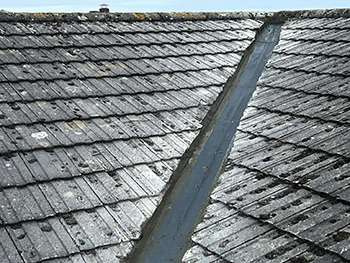
Natural slate is the traditional covering across a lot of South Devon's older housing and remains the standard for listed and conservation-area work. It's dense, low-absorbency and handles coastal wind-driven rain well when laid with the correct headlap for the site's exposure. Good quality slate can last a century or more, though reclaimed and lower-grade imported slate varies hugely in durability.
The main drawback is weight and cost. A slate roof needs a structure designed or checked to carry it, and sourcing slate that matches an existing roof's colour and thickness can be difficult on repair work.
Fibre cement slate
Fibre cement slates are a lighter, more consistent alternative that mimic natural slate's appearance reasonably well from ground level. They're more affordable and easier to source in matching batches, which makes them a common choice for extensions built to blend with an existing slated roof.
They don't weather in the same way as natural slate and can look noticeably different after a decade or two, particularly where algae growth shows differently on the two materials side by side. On a highly visible roof this mismatch matters more than on a rear elevation.
Concrete and clay tile
Concrete tiles are the most common covering on newer housing across Torbay and Newton Abbot, chosen for cost and wide colour range. They're heavier than fibre cement slate but lighter than natural slate per square metre in most profiles, and perform well in exposed locations provided the fixing specification accounts for wind uplift.
Clay tile gives a different character, often used on plain-tiled roofs in older parts of the region, and holds its colour better than concrete over time but costs more and is more brittle to work with, particularly on repairs where matching an old profile is hard.
Exposure, wind and detailing
On exposed coastal sites, the fixing specification matters as much as the material choice. Every slate or tile should be mechanically fixed rather than relying on friction alone, with additional fixing at verges, ridges and hips where wind uplift is highest. Undersized battens or inadequate nail fixings are a common cause of slipped slates on seafront properties.
Underlay quality also matters more on the coast, since wind-driven rain can find its way past the covering during storms even on a well-laid roof. A breathable membrane correctly lapped and taped at penetrations gives a second line of defence that a lot of older roofs never had.
- Check the structure can carry natural slate before specifying it on a new build or extension
- Match slate colour and thickness where visible from the street or from neighbouring properties
- Specify mechanical fixing rated for the site's wind exposure
- Use a breathable underlay with fully taped laps on any coastal reroof
How to specify a reroof
Get the covering, underlay, batten gauge and fixing method written into the quote individually rather than a single line for 'reroofing'. Ask whether the quote assumes like-for-like replacement or whether an upgrade to a lighter or better-fixed system has been considered.
On listed buildings, check what the planning conditions actually require before assuming natural slate is mandatory in every case, since some allow reclaimed or matching fibre cement in less visible areas.
Common questions
Is fibre cement slate a good substitute for natural slate?
It's a reasonable and more affordable option for less visible roofs or where matching an exact colour isn't critical, but it weathers differently over time and won't satisfy planning conditions requiring natural slate on listed buildings.
Do coastal roofs need a different fixing spec?
Yes. Exposed sites need mechanical fixing rated for higher wind uplift, particularly at verges, ridges and hips, along with a well-lapped breathable underlay to catch any wind-driven rain that gets past the covering.
Can I mix tile types on an extension roof?
You can, but a visible mismatch in colour or profile between old and new coverings is hard to disguise. Matching the existing roof as closely as possible usually gives a better result on extensions attached to an existing house.
How long should a reroof last on an exposed site?
Good quality natural slate can last well beyond fifty years even in exposure; concrete tile and fibre cement slate typically have shorter practical lifespans on exposed coastal roofs, especially if fixings weren't specified for the wind loading.
Tell us about the job and we’ll come back with a clear next step.
Serving Paignton, Torbay & South Devon. Mon–Fri 08:00–17:00.
- Lime vs gypsumWhy solid walls need lime and cavity walls need gypsum, and what happens when the two get mixed up.
- Render systemsHow sand and cement, lime and thin-coat renders differ, and which suits which South Devon wall.
- Coastal timber claddingWhich timber species, finishes and fixing details actually survive a South Devon coastal exposure.
- Insulating older homesWhich insulation systems keep older, breathable walls dry instead of trapping moisture inside them.