
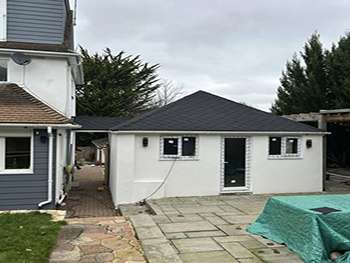
Working through the weather on a South Devon site.
Coastal Devon does not hand builders an easy calendar. Here is how we plan, protect and sequence work so a wet fortnight costs you days rather than months.
Every homeowner asks the same thing in October: will the weather stop my job? The honest answer is that weather rarely stops a well-sequenced build outright — it reshuffles it. What separates a job that limps through winter from one that keeps moving is whether the programme was written with Devon in mind in the first place.
Torbay sits on an exposed south-facing coast. We get driven rain rather than still rain, salt in the air, and wind that arrives from the sea with nothing to slow it down. Scaffold sheeting behaves differently here than it does inland, and so does anything left uncovered overnight.
Sequence the wet-sensitive work into the right window
The trades that genuinely hate weather are a short list: roof coverings, external render, screeds, external masonry in frost, and anything involving a large temporary opening in an occupied house. Everything else — first fix, studwork, internal joinery, plastering behind a watertight envelope — carries on regardless.
So the planning job is simple to state and harder to do: get the envelope closed as early in the programme as the structure allows, then let the internal trades run under cover while the weather does what it likes outside.
- Roof and external openings closed before the internal fit-out starts
- Groundworks and foundations booked around ground conditions, not the calendar
- Render and external decoration held back for a settled run
- Internal trades queued up so there is always dry work available
Protecting an occupied home while the envelope is open
Most of our work is in houses people are still living in. That changes the weather conversation completely — a soaked joist can be dried out, a soaked family cannot be talked round.
Temporary weather protection is not an afterthought on the quote. Monoflex or shrink-wrapped scaffold, properly fixed rather than tied on, temporary roofs over open structures, internal dust and water screens at the boundary between the works and the rest of the house, and floor protection on every route in and out.
- Sheeted scaffold fixed for wind, not just for tidiness
- Temporary roof cover where a structure sits open overnight
- Sealed internal boundary between the works and the living space
- Daily tidy so nothing is left to soak or blow away
What we tell you when the forecast wins
There are days when the right call is not to lift a roof. Wind speed makes working at height unsafe, frost makes mortar pointless, and pouring concrete into standing water helps nobody.
When that happens you get a phone call, not a silent van-less morning. We would rather explain a lost day and move an internal trade forward than pretend a programme is intact when it is not.
Winter is often a better time to book than people think
Because the visible outdoor phases attract the attention, homeowners tend to cluster their enquiries into spring. That makes summer the busiest and least flexible part of the year for every builder in Torbay.
A project that starts its design, planning and structural work over winter is frequently ready to take on the weather-sensitive phases exactly when conditions improve — which is the opposite of joining the spring queue.
Common questions
Will rain delay my extension?
Rain alone rarely stops an extension. It affects groundworks, external masonry, render and roof coverings. Once the structure is watertight, internal work continues in any weather.
Can you start building work in winter?
Yes. Winter suits design work, structural alterations, internal renovation and anything under cover. We plan the weather-sensitive phases around conditions rather than refusing the season.
What happens to my house if the roof is open and it rains?
It should not be open and unprotected. We use sheeted scaffold and temporary covers so the building is protected overnight and through bad forecasts.
Does bad weather cost me more money?
Weather protection is priced into the job from the start rather than added later. Genuinely lost days are discussed with you at the time, not quietly absorbed into the programme.
Tell us about the job and we’ll come back with a clear next step.
Serving Paignton, Torbay & South Devon. Mon–Fri 08:00–17:00.